Standards for RTOs 2025 Explained: What Changed and How to Stay Compliant
Published by Nimbu12 min read

In This Article
- 1. What Are the Standards for RTOs 2025?
- 2. Why the New Standards Matter in 2026
- 3. Standards for RTOs 2025 vs 2015: What Actually Changed?
- 4. Understanding the Four Quality Areas in the New Standards for RTOs
- 4.1. Quality Area 1: Training and Assessment
- 4.2. Quality Area 2: Outcomes for VET Students
- 4.3. Quality Area 3: RTO Practices
- 4.4. Quality Area 4: Governance
- 5. What the Outcomes-Based Standards Mean for Compliance Teams
- 6. How ASQA Audits Will Change Under the New Standards
- 6.1. Audit-Readiness Becomes a Daily Activity
- 6.2. Want to assess your current audit readiness?
- 7. Why Evidence Capture Matters More Than Ever
- 8. Continuous Improvement Is Now an Operational Requirement
- 9. What the New Standards Mean for AVETMISS Reporting
- 10. How Nimbu Supports Compliance Under the Standards for RTOs 2025
- 10.1. Supporting Quality Area 1: Training and Assessment
- 10.2. Supporting Quality Area 2: Outcomes for VET Students
- 10.3. Supporting Quality Area 3: RTO Practices
- 10.4. Supporting Quality Area 4: Governance
- 11. Practical Steps to Prepare for RTO Compliance in 2026
- 11.1. Review Your Evidence Trail
- 11.2. Evaluate Assessment Workflows
- 11.3. Check Reporting Accuracy
- 11.4. Strengthen Continuous Improvement Processes
- 11.5. Assess Operational Visibility
- 12. Frequently Asked Questions
- 13. Resources and Next Steps
- 14. Standards for RTOs 2025 Compliance Checklist
- 15. Quality Area 1: Training and Assessment
- 15.1. Assessment Practices
- 15.2. Training Delivery
- 16. Quality Area 2: Outcomes for VET Students
- 16.1. Student Support
- 16.2. Student Outcomes
- 17. Quality Area 3: RTO Practices
- 17.1. Compliance Reporting
- 17.2. Evidence Management
- 18. Quality Area 4: Governance
- 18.1. Self-Assurance
- 18.2. Continuous Improvement
- 19. Audit-Readiness Check
- 20. Action Plan
For years, many RTOs prepared for compliance by proving they had the right policies, procedures, and documentation in place.
The Standards for RTOs 2025 change that conversation.
The new framework shifts the focus from demonstrating that a process exists to demonstrating that the process produces meaningful outcomes for students. Evidence, continuous improvement, governance, and operational effectiveness now play a much larger role in how compliance is assessed.
For Australian RTOs, this represents more than a regulatory update. It is a shift in how compliance is measured, how audit readiness is maintained, and how training organisations demonstrate quality outcomes.
The question is no longer:
“Do we have the required documentation?”
The question is:
“Can we show that our systems consistently deliver positive student outcomes?”
Understanding this shift is critical for any organisation focused on RTO compliance 2026 and beyond.
What Are the Standards for RTOs 2025?
The new Standards came into effect on 1 July 2025 and introduced a new outcomes-focused approach to vocational education compliance.
Rather than focusing primarily on whether policies and procedures exist, the framework places greater emphasis on:
- Student outcomes
- Evidence-based decision-making
- Continuous improvement
- Risk management
- Operational effectiveness
- Self-assurance
The goal is to ensure that compliance is demonstrated through results rather than documentation alone. This change affects all Australian RTOs, regardless of size, delivery model, or qualification scope.
Why the New Standards Matter in 2026
The new Standards for RTOs are changing how organisations approach compliance.
Under the previous framework, compliance activities were often concentrated around audit preparation. Today, compliance is expected to be visible within everyday operations.
This means RTOs need stronger systems for:
- Evidence capture
- Student support
- Assessment consistency
- Reporting accuracy
- Governance oversight
- Continuous improvement
As a result, many discussions around RTO compliance 2026 are increasingly focused on operational visibility rather than documentation alone.
Standards for RTOs 2025 vs 2015: What Actually Changed?
One of the most significant RTO regulatory changes 2025 introduced is the move from a compliance-focused framework to an outcomes-focused framework.
| Area | 2015 Standards | Standards for RTOs 2025 |
|---|---|---|
| Regulatory Approach | Compliance-focused | Outcomes-focused |
| Structure | 8 Standards | 4 Quality Areas |
| Continuous Improvement | Expected but indirect | Explicit requirement |
| Compliance Evidence | Policy-driven | Evidence and outcomes-driven |
| Audit Focus | Process compliance | Performance and outcomes |
| Governance | Administrative focus | Self-assurance focus |
| Reporting | Reporting requirement | Reporting plus evidence integrity |
The practical implication is clear. RTOs are now expected to demonstrate that systems work effectively, not simply that they exist.
Understanding the Four Quality Areas in the New Standards for RTOs
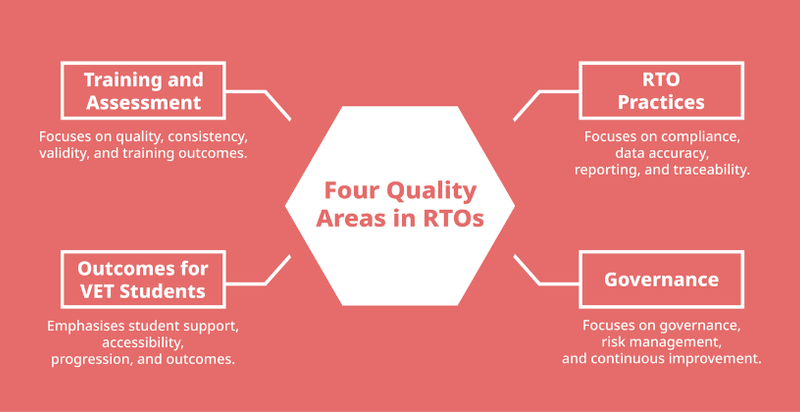
The ASQA Standards 2025 are built around four Quality Areas that define how compliance is assessed.
Quality Area 1: Training and Assessment
This area focuses on the effectiveness of training and assessment practices.
RTOs need to demonstrate:
- Assessment validity
- Consistent delivery
- Appropriate trainer capability
- Effective assessment workflows
- Reliable evidence capture
This places greater emphasis on the quality of training outcomes rather than the existence of training documentation.
Quality Area 2: Outcomes for VET Students
This area reflects the stronger student-centred focus of the new framework. RTOs are expected to demonstrate how students are supported throughout their training journey.
This includes:
- Access to learning resources
- Communication and support
- Student progression
- Accessibility considerations
- Student outcomes
The emphasis is no longer solely on enrolment and completion. It is also on the overall student experience.
Quality Area 3: RTO Practices
This Quality Area focuses on the systems and processes that support delivery.
Areas include:
- Record management
- Compliance reporting
- Data accuracy
- Operational controls
- Evidence traceability
For many organisations, this is where AVETMISS reporting and evidence management become increasingly important.
Quality Area 4: Governance
Governance now plays a more visible role in demonstrating compliance.
RTOs are expected to show:
- Self-assurance practices
- Risk management
- Performance monitoring
- Continuous improvement activities
- Evidence-based decision-making
The focus is on how organisations monitor and improve performance over time.
What the Outcomes-Based Standards Mean for Compliance Teams
The shift to Outcomes-based standards is one of the most significant changes introduced by the Standards for RTOs 2025.
Previously, compliance activities often focused on proving that processes existed. Under the new framework, RTOs are increasingly expected to demonstrate that those processes produce effective outcomes.
This means compliance teams need stronger visibility into:
- Student progression
- Assessment outcomes
- Support effectiveness
- Training quality
- Continuous improvement activities
- Evidence capture practices
The focus moves from “What is documented?” to “What can be demonstrated?” For many RTOs, this requires a closer connection between compliance activities and day-to-day operations.
How ASQA Audits Will Change Under the New Standards
The ASQA Standards explained properly reveal a broader shift in regulatory philosophy.
Rather than relying heavily on periodic audit preparation, ASQA is increasingly adopting a risk-based approach that focuses on outcomes, evidence, and organisational performance.
This means ASQA audits are likely to place greater emphasis on:
- Evidence integrity
- Student outcomes
- Governance practices
- Continuous improvement
- Reporting accuracy
- Assessment consistency
The strongest compliance position is no longer created a few weeks before an audit. It is created through everyday operational practices.
Audit-Readiness Becomes a Daily Activity
One of the biggest implications of the new framework is that audit-readiness becomes an ongoing operational state rather than a temporary project. Evidence should be readily available because it has been captured naturally throughout delivery.
This includes:
- Assessment records
- Student feedback
- Practical observations
- Communication history
- Progress tracking
- Reporting data
RTOs that rely heavily on disconnected systems may find maintaining this visibility increasingly difficult.
Want to assess your current audit readiness?
Check out the Standards for RTOs 2025 Compliance Checklist below to identify potential gaps.
Why Evidence Capture Matters More Than Ever

Effective evidence capture sits at the centre of the new framework.
When evidence is incomplete, inconsistent, or difficult to locate, it becomes harder to demonstrate compliance outcomes.
The new Standards place greater importance on evidence that is:
- Traceable
- Consistent
- Verifiable
- Connected to student activity
- Available when required
This increases the importance of structured assessment workflows, observation records, student progression tracking, and reporting systems. The strongest evidence trails are created during normal operations rather than reconstructed after the fact.
Continuous Improvement Is Now an Operational Requirement
Under the Standards for RTOs 2025, continuous improvement is no longer an implied expectation.
It is a visible requirement.
RTOs are expected to demonstrate how they:
- Monitor performance
- Review outcomes
- Identify opportunities for improvement
- Implement changes
- Measure effectiveness
This applies across multiple areas of the organisation, including:
- Training delivery
- Student support
- Assessment practices
- Governance activities
- Compliance reporting
The expectation is not perfection.
The expectation is that organisations actively review and improve their practices over time.
What the New Standards Mean for AVETMISS Reporting

Accurate AVETMISS reporting has always been important, but the new framework increases the significance of reporting integrity. Reporting data increasingly contributes to broader compliance evidence and outcome validation.
This means organisations need confidence in:
- Student records
- Enrolment information
- Unit outcomes
- Completion status
- Reporting accuracy
Errors that were once viewed primarily as reporting issues may now have broader compliance implications. This is one reason many RTOs are reviewing their reporting workflows as part of broader compliance planning.
How Nimbu Supports Compliance Under the Standards for RTOs 2025
The Standards for RTOs 2025 do not require a specific platform. However, they do increase the importance of systems that support visibility, traceability, and operational consistency. Nimbu was designed around the workflows that Australian RTOs manage every day.
Supporting Quality Area 1: Training and Assessment
Nimbu helps support training and assessment through:
- Marking Dashboard
- Practical Observations
- Learning Journey
- Unit Versioning
- Self-marking assessment types
These tools help create more consistent assessment and evidence workflows.
Supporting Quality Area 2: Outcomes for VET Students
Student-focused features include:
- Microsites
- Mobile-friendly delivery
- Multi-format content support
- Student progress visibility
- Michi Tutor Assistant
These features help support engagement, accessibility, and progression.
Supporting Quality Area 3: RTO Practices
Nimbu supports operational consistency through:
- AVETMISS export functionality
- Role permissions
- Student activity tracking
- Reporting visibility
- Structured record management
Supporting Quality Area 4: Governance
Governance and self-assurance activities benefit from:
- Learning Progress Summary
- Reporting insights
- Activity status tracking
- Evidence visibility
- Workflow transparency
The objective is not simply compliance management. It is creating systems that make compliance easier to demonstrate.
Practical Steps to Prepare for RTO Compliance in 2026
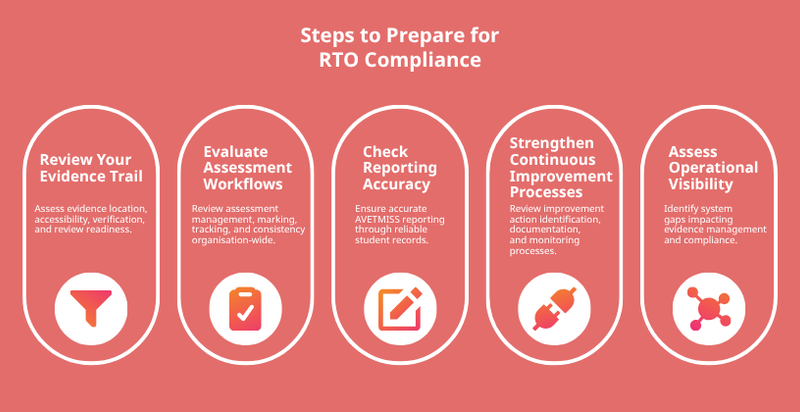
If your organisation is reviewing its readiness under the new framework, start with these priorities.
Review Your Evidence Trail
Assess where evidence currently lives and whether it is easy to locate, verify, and review.
Evaluate Assessment Workflows
Review how assessments are managed, marked, and tracked across the organisation.
Check Reporting Accuracy
Ensure student records and reporting processes support accurate AVETMISS submissions.
Strengthen Continuous Improvement Processes
Review how improvement actions are identified, documented, and monitored.
Assess Operational Visibility
Identify areas where disconnected systems may create gaps in evidence or compliance oversight. Small improvements made now can significantly reduce compliance pressure later.
Frequently Asked Questions
Do the Standards for RTOs 2025 apply to every Australian RTO?
Yes. The Standards for RTOs 2025 apply to all registered training organisations regardless of size, delivery model, or qualification scope.
What is the biggest change in the Standards for RTOs 2025?
The biggest change is the move towards Outcomes-Based Standards, where RTOs are expected to demonstrate effective outcomes rather than simply show that processes exist.
How are the new Standards for RTOs different from the 2015 framework?
The new Standards for RTOs place greater emphasis on student outcomes, evidence-based decision-making, governance, self-assurance, and continuous improvement.
How will ASQA audits change under the new framework?
Future ASQA audits are expected to focus more heavily on evidence, outcomes, risk management, and operational effectiveness rather than documentation alone.
What are Outcomes-Based Standards?
Outcomes-Based Standards focus on the results produced by an organisation’s systems and practices rather than solely on the existence of policies and procedures.
How can RTOs prepare for compliance in 2026?
RTOs should review evidence capture processes, assessment workflows, reporting accuracy, governance practices, and continuous improvement activities to ensure alignment with the new framework.
Can an LMS help support compliance under the Standards for RTOs 2025?
Yes. A structured LMS can support evidence capture, student progression tracking, assessment workflows, reporting consistency, and audit readiness, making compliance easier to demonstrate.
Resources and Next Steps
The transition to the Standards for RTOs 2025 is not simply a regulatory update. It represents a broader shift towards evidence-based, outcomes-focused compliance.
For Australian RTOs, the organisations best positioned for long-term success will be those that embed compliance into everyday operations rather than treating it as a periodic activity.
Standards for RTOs 2025 Compliance Checklist
Use this checklist to assess your organisation’s readiness under the Standards for RTOs 2025.
The goal is not simply to confirm that policies exist. The new framework requires RTOs to demonstrate that systems, processes, and practices produce positive outcomes for students.
Quality Area 1: Training and Assessment
Assessment Practices
☐ Assessment tools are current and version controlled
☐ Assessment evidence is consistently captured and retained
☐ Assessment decisions can be traced back to supporting evidence
☐ Trainer and assessor practices are monitored for consistency
☐ Validation activities are documented and reviewed
☐ Assessment workflows support reliable evidence collection
Training Delivery
☐ Training delivery aligns with student cohort needs
☐ Training resources remain current and relevant
☐ Students can access required learning materials
☐ Practical observations are documented consistently
☐ Student progression can be monitored throughout delivery
Quality Area 2: Outcomes for VET Students
Student Support
☐ Students receive clear information before enrolment
☐ Support services are available and documented
☐ Student communication processes are consistent
☐ Students can easily access learning materials and assessments
☐ Student feedback is collected and reviewed
Student Outcomes
☐ Student completion data is monitored regularly
☐ Progression trends are reviewed
☐ Student engagement is measured
☐ Improvement actions are implemented when issues are identified
☐ Evidence exists to demonstrate student support effectiveness
Quality Area 3: RTO Practices
Compliance Reporting
☐ AVETMISS reporting processes are documented
☐ Student records are accurate and up to date
☐ Reporting data is reviewed before submission
☐ Reporting responsibilities are clearly assigned
☐ Reporting errors are tracked and corrected
Evidence Management
☐ Compliance evidence is centrally accessible
☐ Evidence can be located quickly during audits
☐ Assessment records are complete
☐ Observation records are maintained
☐ Record retention requirements are being met
Quality Area 4: Governance
Self-Assurance
☐ Compliance risks are reviewed regularly
☐ Governance decisions are supported by operational data
☐ Internal reviews occur on a scheduled basis
☐ Compliance findings are documented and actioned
☐ Improvement initiatives are tracked to completion
Continuous Improvement
☐ Continuous improvement activities are documented
☐ Training and assessment outcomes are reviewed regularly
☐ Student feedback informs decision-making
☐ Improvement actions are monitored for effectiveness
☐ Evidence exists to demonstrate completed improvements
Audit-Readiness Check
Can your organisation quickly provide evidence for:
☐ Assessment decisions
☐ Student progression
☐ Practical observations
☐ Student support activities
☐ Trainer feedback
☐ Continuous improvement actions
☐ Governance reviews
☐ AVETMISS reporting accuracy
If any of the above would require extensive manual searching, spreadsheets, or evidence reconstruction, those areas may require further review.
Action Plan
After completing this checklist, identify:
Immediate Priorities (Next 30 Days)
Medium-Term Improvements (Next 90 Days)
Long-Term Compliance Improvements (Next 12 Months)
*This article provides general information about the Standards for RTOs 2025 to help Australian RTOs understand the framework. It does not constitute regulatory or legal advice. For specific compliance requirements, consult ASQA’s official guidance at asqa.gov.au or engage a qualified VET compliance professional. The Standards for RTOs 2025 are subject to update and interpretation by ASQA — this article reflects publicly available information at time of publication on Jul 2025.
Related Topics

Start Your 30 Day FREE Trial Today!
Obligation free, no contracts, unlimited access, get started in less than a minute!
- Free training and onboarding
- 30 Days free trial
- No contracts
- Obligation free
- Unlimited use of Nimbu and all the features