Why Australian Training Providers Are Choosing an RTO LMS in 2026
Published by Nimbu7 min read

In This Article
- 1. Why Australian RTOs Are Replacing Generic LMS Platforms in 2026
- 2. Where Generic Learning Management Systems Fall Short for RTOs
- 2.1. Compliance Workflows Live Outside the Platform
- 2.2. Reporting Requires Too Much Manual Work
- 2.3. Every New Requirement Means Another Tool
- 3. What an RTO LMS Australia Platform Should Actually Deliver
- 3.1. Assessment Management That Supports Trainers
- 3.2. Student Progress Tracking With Real Visibility
- 3.3. Flexible Delivery Models
- 3.4. Reporting That Supports Daily Operations
- 4. How a Compliance-Focused LMS for Australian RTOs Supports Daily Operations
- 5. Why Nimbu Is Built for Australian Vocational Education
- 5.1. Assessment Management Without Spreadsheet Tracking
- 5.2. Practical Observations Built Into Delivery
- 5.3. Student Progress Visibility
- 5.4. AVETMISS Reporting Simplified
- 5.5. AI That Supports Existing Workflows
- 6. Generic LMS vs RTO LMS Australia: What’s the Difference?
- 7. When Should You Replace Your LMS?
- 8. Frequently Asked Questions
Many Australian RTOs aren’t replacing their LMS because it stopped working. They’re replacing it because it was never built for vocational education in the first place.
A platform designed for universities, schools, or corporate learning can technically deliver content. But when it comes to Practical Observations, AVETMISS reporting, compliance workflows, qualification structures, and audit-ready evidence, those systems often rely on workarounds.
For years, those workarounds were manageable. Today, they are becoming increasingly expensive.
The introduction of the new Standards for RTOs, greater emphasis on evidence capture, growing student expectations, and increasing reporting requirements have changed what organisations need from technology.
This is why more providers are choosing an LMS built specifically for Australian RTOs rather than a generic learning platform.
The question is no longer:
“Can our LMS deliver learning content?”
The question is:
“Can our LMS support the way an RTO actually operates?”
See how Nimbu supports compliance, reporting, assessments, and student management in one platform.
Why Australian RTOs Are Replacing Generic LMS Platforms in 2026

An increasing number of Australian RTOs are reviewing whether their existing LMS still supports the realities of modern training delivery.
Many systems were implemented years ago when:
- Student numbers were smaller
- Compliance requirements were less demanding
- Online delivery was simpler
- Reporting expectations were lower
Today, organisations need to manage:
- Student progression
- Assessment management
- Compliance workflows
- AVETMISS reporting
- Blended delivery
- Evidence collection
When an LMS cannot support these activities efficiently, teams often create manual processes around the system.
Those processes become harder to maintain as organisations grow.
Where Generic Learning Management Systems Fall Short for RTOs
Many learning management system platforms are designed for broad education markets.
They can deliver content effectively, but vocational education requires much more than content delivery.
Compliance Workflows Live Outside the Platform
One of the biggest challenges with generic systems is that important compliance activities often happen elsewhere.
Evidence may be stored across:
- Shared drives
- Email inboxes
- Paper forms
- Individual devices
- External applications
This creates unnecessary complexity and makes compliance harder to manage.
An effective RTO compliance LMS should make evidence capture part of normal delivery rather than a separate administrative process.
Reporting Requires Too Much Manual Work
Many organisations still spend significant time preparing data for reporting purposes.
Without structured workflows, AVETMISS reporting can become a repetitive administrative task involving exports, spreadsheets, and manual validation.
The more disconnected the data, the greater the reporting burden.
Every New Requirement Means Another Tool
Generic platforms often require separate systems for:
- Practical Observations
- Student portals
- Reporting
- Content creation
- Communication
- Progress tracking
Over time, organisations end up managing multiple disconnected systems instead of one unified environment.
What an RTO LMS Australia Platform Should Actually Deliver

A modern RTO LMS Australia platform should support more than learning content.
It should help organisations manage compliance, reporting, assessment workflows, and student engagement from one location.
Assessment Management That Supports Trainers
Strong assessment management workflows help trainers focus on feedback and student support rather than administrative tracking.
A platform should make it easy to:
- Monitor submissions
- Manage marking
- Track revisions
- Maintain assessment records
Student Progress Tracking With Real Visibility
Effective student progress tracking allows trainers and administrators to identify issues before they become barriers to completion.
Without visibility, support becomes reactive rather than proactive.
Flexible Delivery Models
Modern training organisations deliver through a combination of:
- Online learning
- Face-to-face training
- Workplace delivery
- Self-paced learning
An LMS should support these models without creating additional administrative complexity.
Reporting That Supports Daily Operations
An AVETMISS-ready LMS should make reporting part of everyday operations rather than a separate project.
When reporting data is collected accurately throughout the student journey, compliance becomes easier to manage.
How a Compliance-Focused LMS for Australian RTOs Supports Daily Operations
The best LMS for Australian RTOs supports operational efficiency behind the scenes.
Rather than forcing teams to adapt their processes to the software, the platform should align with how vocational education is delivered.
This means supporting:
- Compliance reporting
- Student management
- Evidence collection
- Assessment workflows
- Training delivery
- Qualification management
The goal is not simply to digitise existing processes. The goal is to create more efficient workflows.
Why Nimbu Is Built for Australian Vocational Education
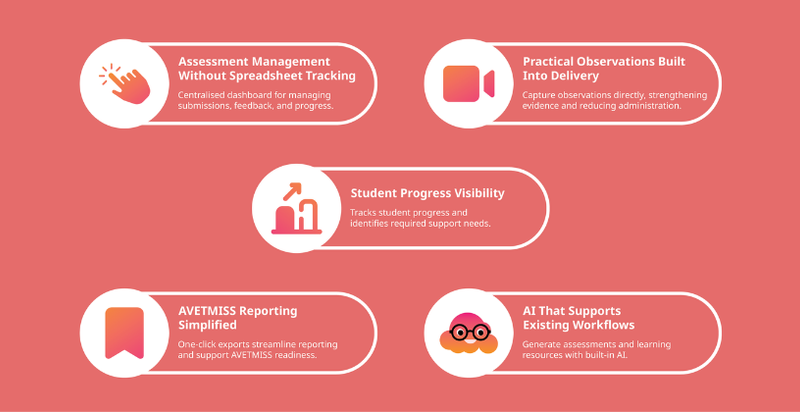
Nimbu was developed specifically for the operational realities of vocational training software Australia providers require.
Instead of focusing solely on content delivery, Nimbu helps support the full student journey.
Assessment Management Without Spreadsheet Tracking
The Marking Dashboard helps trainers manage assessment activity from one location.
Rather than moving between multiple systems, trainers gain visibility over submissions, feedback, and progress.
Practical Observations Built Into Delivery
Observations can be captured directly within the platform and linked to student records.
This creates stronger evidence trails while reducing administrative effort.
Student Progress Visibility
Learning Progress Summary helps trainers, administrators, and compliance teams understand where students are progressing and where support may be required.
AVETMISS Reporting Simplified
Nimbu’s quick export functionality helps streamline reporting processes and supports an AVETMISS-ready LMS workflow.
AI That Supports Existing Workflows
Nimbu includes two AI assistants that support different roles throughout the training lifecycle.
Michi AI Assistant helps content editors create assessments, quizzes, learning materials, articles, and pre-training review resources more efficiently, reducing the time spent on repetitive course development.
Michi Tutor Assistant supports student s by answering course-related questions, explaining concepts, and helping students navigate their learning without waiting for trainer assistance.
Together, these AI assistants streamline course development, improve student support, and reduce repetitive administrative work across the platform.
Generic LMS vs RTO LMS Australia: What’s the Difference?
The difference becomes clear when comparing operational requirements.
| Workflow | Generic LMS | RTO LMS Australia |
|---|---|---|
| Assessment Management | Often requires workarounds | Built into delivery workflows |
| Practical Observations | External tools required | Integrated observations |
| Compliance Reporting | Manual processes | Structured workflows |
| AVETMISS Reporting | Often disconnected | AVETMISS-ready functionality |
| Student Progress Tracking | Limited visibility | Progress-focused reporting |
| Evidence Collection | Multiple locations | Centralised records |
| Training Delivery | Content-focused | Vocational education-focused |
The distinction is not about features. It is about how well the platform supports vocational education operations.
When Should You Replace Your LMS?

Not every organisation needs to replace its LMS immediately. However, there are common signs that a platform may no longer be the right fit.
You may want to evaluate alternatives if:
- Compliance activities rely on manual workarounds
- Reporting takes excessive time
- Evidence is difficult to locate
- Trainers avoid using the system
- Student progress is hard to track
- Growth creates administrative bottlenecks
- Multiple external tools are required to complete basic workflows
These challenges often indicate that the platform was not designed for the operational realities of an RTO.
Frequently Asked Questions
Why are Australian RTOs replacing generic LMS platforms?
Many generic platforms were designed for universities, schools, or corporate learning environments. As compliance requirements and delivery complexity increase, RTOs often need systems built specifically for vocational education workflows.
What is the difference between a generic LMS and an RTO LMS Australia platform?
A generic LMS focuses primarily on content delivery, while an RTO LMS Australia platform supports assessments, observations, compliance workflows, reporting, and student management.
When should an RTO replace its LMS?
An RTO should consider replacing its LMS when administrative workload, reporting challenges, compliance visibility issues, or operational inefficiencies begin affecting delivery outcomes.
Can an LMS improve AVETMISS reporting?
Yes. An AVETMISS-ready LMS helps centralise student data and streamline reporting workflows, reducing manual effort.
Does replacing an LMS reduce administration?
It can. A platform designed specifically for vocational education often removes duplication, improves visibility, and reduces reliance on disconnected systems.
How does Nimbu support vocational education delivery?
Nimbu supports assessment management, student progress tracking, Practical Observations, compliance reporting, AVETMISS workflows, and AI-assisted content creation within a single platform.
Related Topics

Start Your 30 Day FREE Trial Today!
Obligation free, no contracts, unlimited access, get started in less than a minute!
- Free training and onboarding
- 30 Days free trial
- No contracts
- Obligation free
- Unlimited use of Nimbu and all the features